
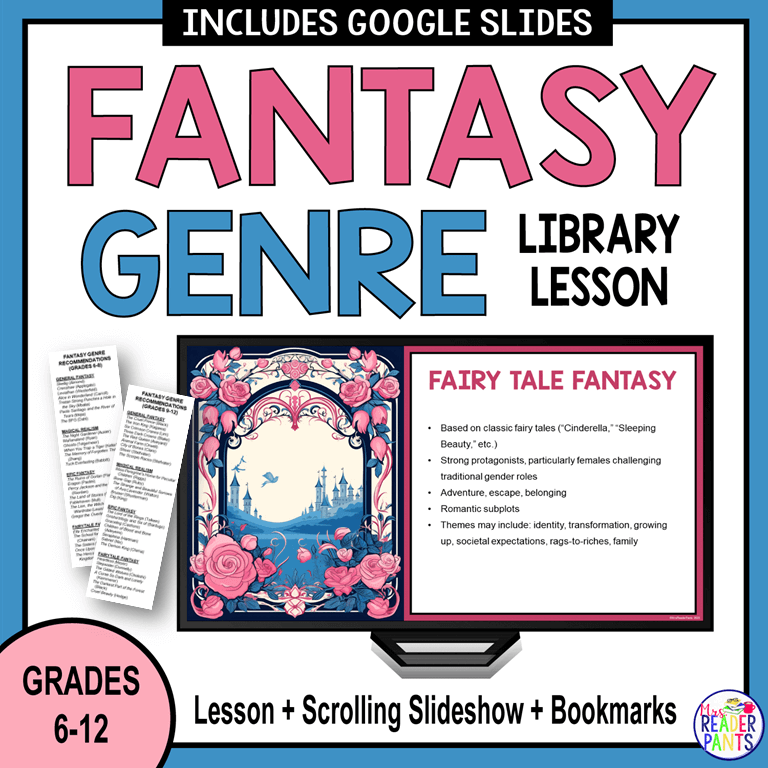

This Fantasy Genre Library Lesson is for middle school library and high school library classes.
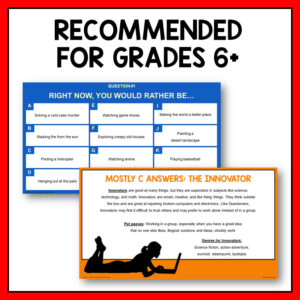
Part 1 introduces the fantasy genre, with emphasis on characteristics of fantasy and fantasy subgenres. Part 2 is a scrolling slideshow with trivia questions, classic fantasy genre literature quotes, would you rather’s, and more!
Though students may be familiar with the featured stories from movies, this presentation emphasizes fantasy literature, not movies.
This lesson has 59 total pages and slides, and it includes:
- 55-slide Lesson Presentation in Microsoft PowerPoint + Google Slides
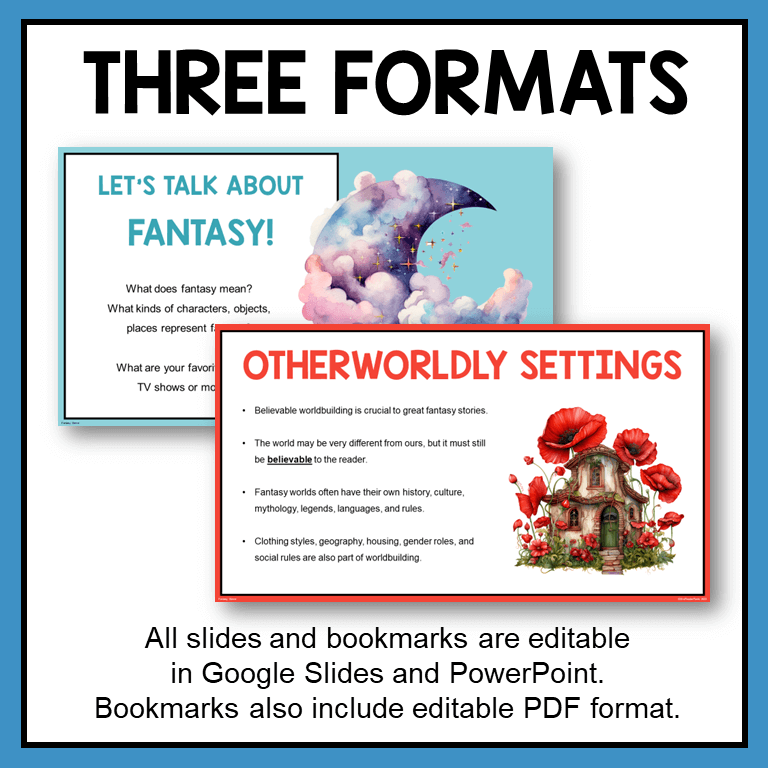
- All body text is editable; you choose which slides you want to use.
- 25 slides are whole class lesson slides.
- 29 slides are “scrolling presentation” slides that are great for extending lessons or scrolling in the library during checkout and downtimes.
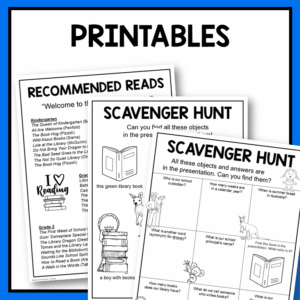
- List of 52 recommended books to accompany this lesson (2 pages, PowerPoint and PDF)
- The list is editable and great to hand out to parents, teachers, and students looking for related books.
- Google Classroom Basics (4 pages, PDF)
- Instructions on how to set up PowerPoint slide timings for scrolling slides (2 pages, PDF)
25 Lesson Slides:
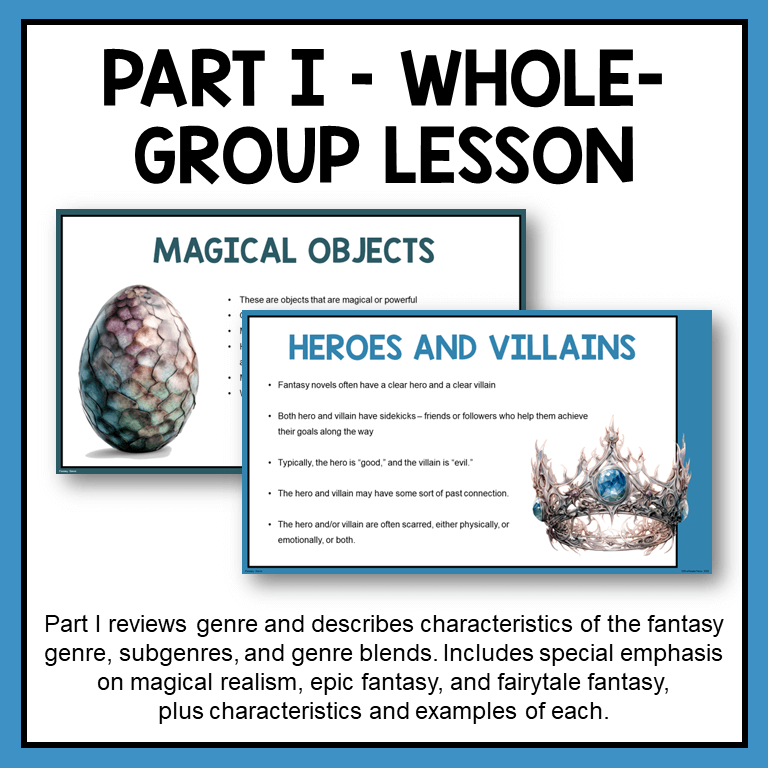
Part 1 is a guided whole-class discussion. The slides walk you through the entire class discussion, from start to finish.
- Review of genre (what is genre)
- Students’ preliminary thoughts on the fantasy genre
- Characteristics of the fantasy genre
- Why we should read the fantasy genre (promotes imagination, escapism, complex worldbuilding, allegorical to real events)
- Fantasy often mixes with other genres – e.g., romance, historical fiction (steampunk), science fantasy, etc.
- Importance of worldbuilding
- The rules of magic
- Magical objects
- Heroes and villains
- Motivations of heroes and villains
- Anti-heroes
- Fantasy creatures
- List of fantasy subgenres
- Subgenre focus – magical realism – characteristics and examples
- Subgenre focus – epic fantasy – characteristics and examples
- Subgenre focus – fairytale fantasy – characteristics and examples
- 2 slides for checkout procedures and reminders
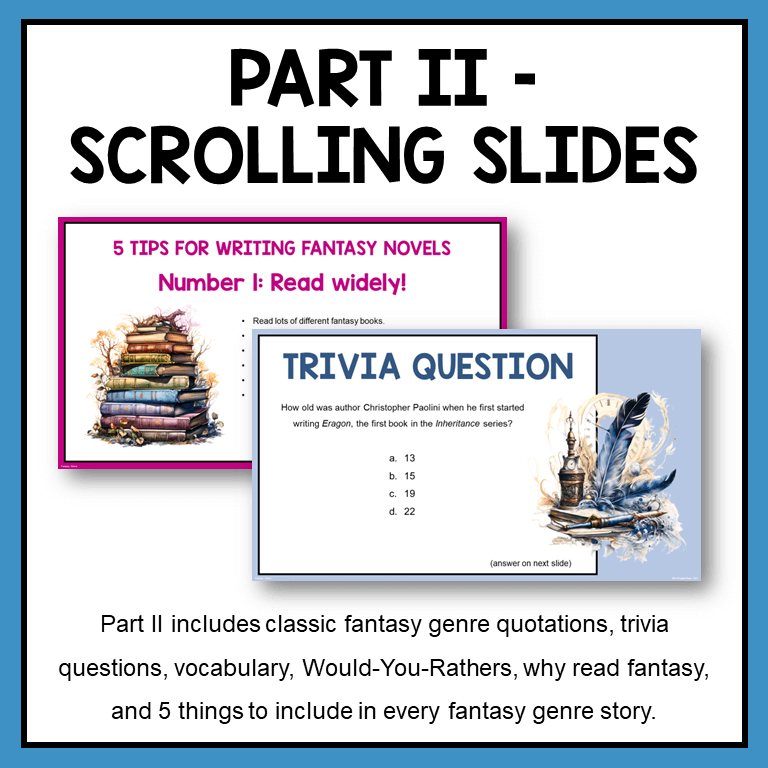
29 Scrolling Slides:
Part 2 is the scrolling slides. Set them on a timer to scroll on a screen during library checkout. If you time the slides at 45 seconds each, the historical fiction genre slideshow will be 22 minutes in length.
- Words of the Week: “parallel universe” and “archetype”
- 5 tips for writing fantasy
- Literary terms: parallel universe, allegory, series, show don’t tell, hero, anti-hero, motivation
- What is the hero’s journey
- 9 stages of the hero’s journey
- 4 would you rather’s and 3 trivia questions + answers and 1 what do you think
- Daily and weekly schedule
- Announcements
- Reminders
- This week’s birthdays
Fantasy Literature Mentioned:
- “Alice in Wonderland” by Lewis Carroll
- “The Lord of the Rings” trilogy by J.R.R. Tolkein
- “The Lion, the Witch, and the Wardrobe” by C. S. Lewis
- “Animal Farm” by George Orwell
- “Eragon” by Christopher Paolini
- “Harry Potter” series by J.K. Rowling
- “Shadow & Bone” by Leigh Bardugo
- “Half Bad” by Sally Green
- “A Monster Calls” by Patrick Ness
- “100 Years of Solitude” by Gabriel García Márquez
- “The Weight of Blood” by Tiffany D. Jackson
- “Skellig” by David Almond
- “The Wizard of Oz” by L. Frank Baum
- “Pivot Point” by Kacie West
- “Discworld” series by Terry Pratchett
- “The Wheel of Time” series by Robert Jordan
- “Ranger’s Apprentice” series by John Flanagan
- “Redwall” series by Brian Jacques
- “The Odyssey” by Homer
- “The Epic of Gilgamesh”
- “The Book of One Thousand and One Nights” / “Arabian Nights”
- “Sir Gawain and the Green Knight”
- Multiple YA and middle school titles mentioned with the 3 fantasy fiction subgenre focuses (magical realism, epic fantasy, fairytale fantasy)
Recommended Reads Booklists:
- One bookmark is Grades 6-8, and the other is Grades 9-12.
- All titles are recommended for Grades 6-8 and 9-12.
- All titles received positive reviews from professional library journals. Many received starred reviews.
Standards Addressed:
AASL National School Library Standards – See the AASL Standards Framework for Learners to view full text.
- Inquire – A.2. – C.1. – D.3.
- Include – B.1. – C.2.
- Collaborate – A.2. – B.2.
Common Core English Language Arts Standards –
© Copyright 2010 National Governors Association Center for Best Practices and Council of Chief State School Officers. All rights reserved.
- CCSS.ELA-Literacy.RL.6.9. – CCSS.ELA-Literacy.RL.6.10.
- CCSS.ELA-Literacy.RL.7.3. – CCSS.ELA-Literacy.RL.7.10.
- CCSS.ELA-Literacy.RL.8.3. – CCSS.ELA-Literacy.RL.8.10.
- CCSS.ELA-Literacy.RL.9-10.4. – CCSS.ELA-Literacy.RL.9-10.10.
- CCSS.ELA-Literacy.RL.11-12.4. – CCSS.ELA-Literacy.RL.11-12.10.
Terms of Use
© Mrs. ReaderPants – By purchasing this product, you receive a one-user license. Copying or distributing to others is prohibited. See our Site Terms of Use for more information. For teacher-librarians: You may use this product with all of your classes and students.
Questions before buying? If the free preview file does not answer your question, you can contact us through this link with questions.


Reviews
There are no reviews yet.